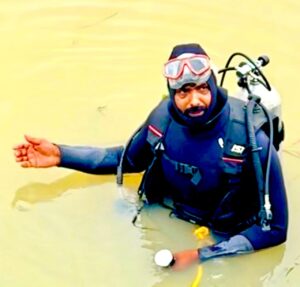
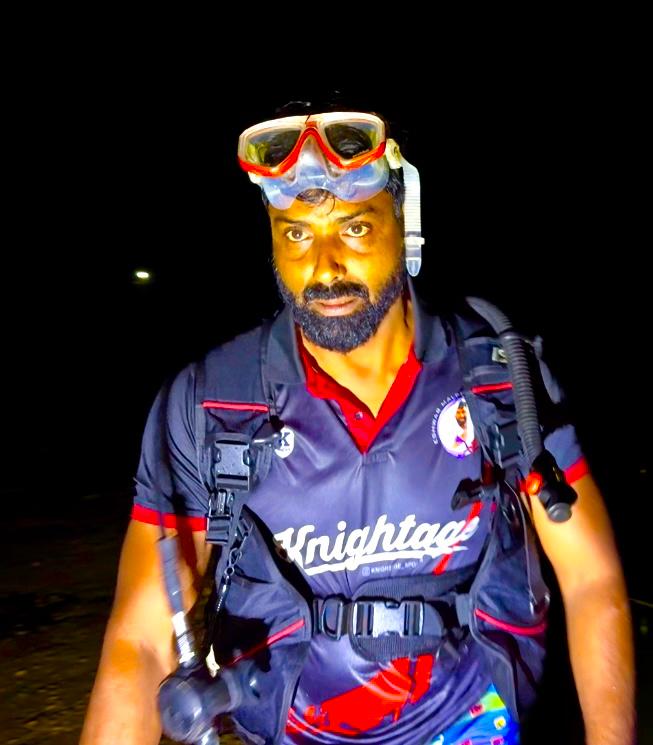
Along the coast of Malpe in Karnataka, one man has spent over two decades doing what few others dare diving into uncertain waters to bring closure to families who have lost loved ones to the sea. His name is Eashwar Malpe, and for the last 20 years, he has been the person local police and villagers call when someone goes missing in rivers, lakes, or the ocean.
Born and raised in Malpe, Eashwar’s life began far from the recognition he receives today. As a child, he dreamt of joining the military, but financial struggles, his mother’s ill health, and poor academic performance prevented him from pursuing that path. “I wanted to serve the country,” he recalls. “When that couldn’t happen, I decided to serve people in another way.”
Growing up near the sea, Eashwar learned to swim early. He would often swim the 2.5 km stretch from the Malpe coast to a nearby island, spending long hours in the water. Those formative experiences unknowingly prepared him for the work he does today.
After marriage, Eashwar’s life was marked by personal hardships. His wife and he had three children…all born with disabilities, one of whom passed away. “There was a time I didn’t know where to go or what to do,” he says. Yet, instead of giving up, he turned to the one element that had always been part of his life, the sea. That decision changed everything.
A Lifesaving Mission
For the last two decades, Eashwar has carried out over 2,500 recovery and rescue operations across Karnataka. Though he maintains no formal record, local police confirm his team’s presence at numerous accident and drowning sites. “We don’t work for records,” he says simply. “We work to help.”
He leads a small group of 10–15 volunteers, most of whom are drivers or swimmers who assist in transport and logistics. Their operations are entirely self-funded — no financial support comes from the government or NGOs. When an incident occurs, calls often come directly from the police or families in nearby villages. Eashwar and his team arrive with their own ambulance and basic equipment, offering their services free of cost.
Their rescue kit includes scuba suits, oxygen cylinders, underwater torches, and cameras — all purchased with personal funds or small contributions from local well-wishers. “An oxygen kit alone costs nearly ₹2 lakh,” he explains. “We’ve bought them ourselves because there’s no government support.”
The Challenges Below the Surface
Eashwar’s work is not only physically demanding but also extremely dangerous. “Anything can happen underwater — crocodiles, snakes, strong currents,” he says. The most difficult operation of his career came during the Shiruru landslide in Karnataka, about two years ago. “We searched for 73 days,” he recalls. “Thirteen people had lost their lives. One of them, a driver named Arjun from Kerala, was found after 72 days.”
Heavy rains, high water pressure, and near-zero visibility made the operation almost impossible. “We couldn’t see anything in the water. The current was strong, and debris from the landslide made it even worse,” he adds.
Community Trust and Police Cooperation
Though his team is not officially affiliated with the government, the Coastal Security Police in Malpe have recognized their contribution and even trained alongside them for the past 4–5 years. “They’ve learned sea-swimming and rescue techniques from us,” he mentions.
Despite this collaboration, Eashwar’s team still operates independently, without formal certification. “We do this as social service,” he says. “That’s why people trust us. We never take money.”
Plans for the Future
Looking ahead, Eashwar hopes to establish a swimming academy for children and youth in coastal areas. “If young boys and girls learn swimming early, they can save lives — maybe even become divers or rescuers themselves,” he says. His dream is simple: that his work inspires others to continue what he started.
Yet, sustainability remains a challenge. “We need government help. Equipment is expensive, and without support, we can only do so much,” he says. For now, he continues to fund operations through personal earnings and small donations from locals.
Recognition and Support
Over the years, his work has been featured by numerous newspapers and TV channels, earning him local recognition and several community awards. But for Eashwar, the true reward lies elsewhere. “When a family finds peace — that’s my award,” he says.
His family, too, stands firmly behind him. Despite personal loss and ongoing struggles, they support his mission wholeheartedly. “My family understands why I do this,” he says. “They are my strength.”