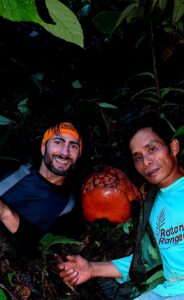

After years of searching through remote forests, a rare Rafflesia flower finally opened in Sumatra in November 2025. The moment brought together two worlds — the instinctive field knowledge of a local tracker and the scientific study of an Oxford botanist — and highlighted how fragile this species truly is.
A local tracker’s lifetime of searching
Septian “Deki” Andriki began documenting Rafflesia in 2011. Growing up near the mountains of Bengkulu, he often found unusual forest plants as a child. Years later, while filling in for a biology lesson, he noticed that his textbook had incorrectly compared Rafflesia to the corpse flower. That mistake pushed him to look deeper into its real habitat.
In 2017, after months of fieldwork with Rafflesia expert Agus Susatya, Deki helped identify a new species, Rafflesia kemumu. The success strengthened his commitment. For the November 2025 bloom, he spent months tracking a single bud in a forest with no phone signal, long treks, and no clear trails — one reason many Rafflesia blooms go undocumented.
Deki has seen Rafflesia grow in many types of forests, from coastal lowlands to higher mountain slopes. What the plant needs most is humidity and thick, shady forest cover. Any major clearing, drying, or heat exposure kills the buds. He also warns that squirrels and certain birds sometimes destroy the young buds before they ever bloom.
The flower’s survival depends entirely on Tetrastigma, a type of wild vine related to grapes. Rafflesia lives inside this vine for most of its life, making it impossible to grow the flower without its host.
What scientists saw
Dr. Chris Thorogood from the University of Oxford, who has spent years trying to see R. hasseltii in bloom, joined the mission. Rafflesia is one of the world’s strangest plants: it has no leaves, no roots, no stem, and no green colour. It lives hidden inside its host vine and only appears when it produces a large, dramatic flower.
The November 2025 bloom measured about 60 cm across. Chris describes its red-and-white pattern and bright orange centre as “otherworldly.” For his team, this bloom offered valuable information about the plant’s size, colour, condition, and the state of its habitat.
Why this matters
Researchers estimate that around 60% of all Rafflesia species are threatened with extinction. No one knows the exact population of R. hasseltii, but the biggest danger is clear: the loss of healthy forest.
Because the plant cannot grow without its host vine and its exact forest conditions, it is extremely hard to protect. Chris explains that trying to grow Rafflesia outside its natural home has rarely succeeded — protecting the forest is the only real solution.
Deki sees the changes firsthand: large areas of forest turned into oil-palm plantations, illegal logging, and land-use changes. He believes most people don’t realise that protecting Rafflesia is everyone’s responsibility, not just the scientists’.
Local communities and conservation action
There is hope. Deki says many local villagers want to protect Rafflesia habitats. He has started a “Save Rafflesia Habitat” movement and is working with Indonesia’s national research agency BRIN, Chris’s team, and local botanical institutions to properly document species and update old records.
At the Bogor Botanical Garden, researchers are experimenting with growing the host vines to see if that can eventually help conservation. So far, only one R. hasseltii has been seen this way — more research is needed.
Life cycle and urgency
Deki has recorded three main stages before a flower opens: early swelling, formation of protective layers, and the final opening structure. A bud usually takes about nine months before it blooms — and once it opens, the flower lasts only seven days. This makes every single bloom important.
Where the research goes next
There is still much to learn: how the parasite and host interact, how many species remain undiscovered, and how forests must be protected for long-term survival. Chris and Deki will continue monitoring sites, documenting blooms, and working with Indonesian institutions to create better protection plans.
Conclusion
The November 2025 bloom was more than a rare sighting. It showed what happens when deep local knowledge meets scientific research. But it also reminded the world how delicate this plant is. If forest loss continues, Rafflesia may fade away long before we fully understand it. Protecting these extraordinary flowers starts with protecting the forests they depend on.