
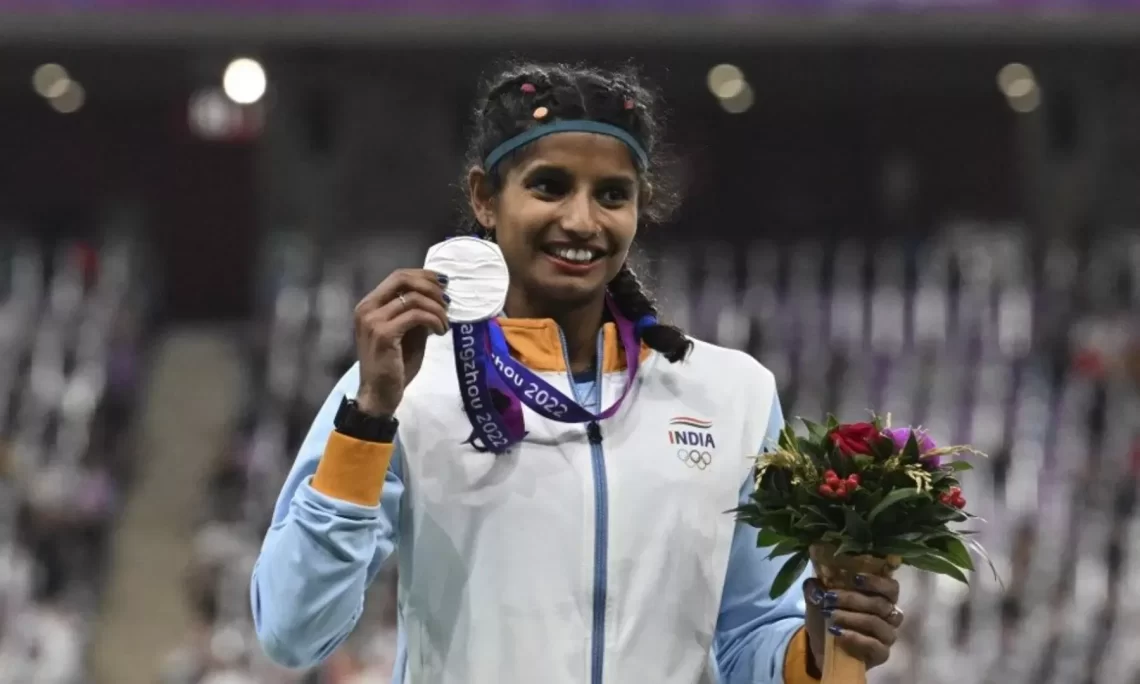
When Ancy Sojan first competed at a district championship in Thrissur, she did it barefoot. She was 13 or 14 years old, had no spikes, and no clear sense yet of where athletics would take her. It was only after she met her first coach — around 2012 — that she was introduced to spikes, structured training, and the possibility that sport could become something more than play.
That possibility would eventually grow into an Asian Games silver medal, a personal best of 6.71 metres, and a place among India’s most consistent long jumpers.
From an auto-rickshaw ride to the track
Ancy’s early years in sport were shaped as much by circumstance as talent. Her parents noticed early on that she was constantly active — always running, playing, unable to sit still. She tried everything in school: classical dance, skits, speeches, reading competitions. Sports, however, slowly stood out.
Her father, an auto-rickshaw driver at the time, would often transport athletes to training. One day, watching them closely, he wondered if his daughter could also belong on the track. After Ancy won silver and bronze medals in sprint events at the sub-district level, her father approached one of the coaches — a decision that would quietly change the course of her life.
Initially, Ancy trained as a middle-distance runner, doing 600m and 800m sessions, before being identified as a sprinter. Long jump came later, almost accidentally. Her first competitions were frustrating — she repeatedly missed the take-off board, fouling jumps that otherwise had distance. At one inter-school meet, her father was visibly upset. Her coach, however, saw something different: even without hitting the board, her jumps were longer than others’.
“She has the calibre,” he insisted. “We just need to train her.”
Ancy continued competing in both sprints and long jump, slowly learning the technical discipline the event demands.
Dreams shaped by speed and sacrifice
Like many young sprinters, Ancy idolised Usain Bolt. She remembers watching him on television, studying his blocks, his white spikes, replaying his races on YouTube. Inspired, she began collecting her own medals — lining them up on an iron rod shelf at home — imagining a future filled with podiums.
That future demanded sacrifices early. School trips, social functions, celebrations — Ancy missed many of them to protect her training rhythm. “If you break one session, it’s very hard to come back,” she explains. The people who would later congratulate her victories were often absent during those quiet years of discipline.
By her own count, she would go on to win more than 100 medals at national-level competitions.
Choosing long jump — and choosing longevity
Until 2021, Ancy competed in multiple events: 100m, 200m and long jump. Coaches even suggested she try the 400m. But she was clear about one thing — she wanted to be an individual international medallist.
That clarity sharpened in October 2021, when she joined the national jumps camp in Bengaluru. From that point, sprinting became a tool, not an event. She stopped competing in track races and began training speed exclusively for long jump.
The decision wasn’t easy. Multiple events had contributed to recurring hamstring and quadriceps injuries. Eventually, the federation made it clear: if she continued sprinting in competitions, she risked being dropped from camp. Long jump would have to become her singular focus.
Discipline over drama
Ancy’s training philosophy is rooted in consistency rather than shortcuts. She compares it to meditation — a daily practice that demands discipline and constant awareness. Her training days often involve two sessions, stretching from early morning speed and technical work to evening strength and cooldowns that can run late.
There is no “last-minute preparation” in elite athletics, she says. Missed sessions accumulate. Progress is slow and earned.
That mindset would prove critical during one of the most important phases of her career.
The Asian Games: calm under pressure
Just months before the Asian Games, Ancy narrowly missed a medal at the Asian Championships in Bangkok — finishing only centimetres away from the podium. The disappointment weighed heavily on her. To make matters harder, her personal coach wasn’t present, and she struggled to maintain rhythm on the runway.
That experience pushed her toward sports psychology. Working with psychologist Dr. Stalin Joseph, Ancy began learning how to identify errors herself — not emotionally, but analytically. Within weeks, she could articulate technical corrections even before her coach spoke.
By the time she arrived in Hangzhou for the Asian Games, something had shifted.
Despite concerns about her form in the lead-up, she felt unusually calm. She explored the Games Village, read, drew, spoke to family, and stayed relaxed. On competition day, she felt present — not anxious.
Standing on the runway, she looked at the Indian flag and made herself a promise: I will fly up there on the podium.
She delivered. Her fifth jump stretched to 6.63 metres — then a personal best — earning her the silver medal. Watching later, her psychologist remarked that her body language had revealed what numbers eventually confirmed: confidence.
Learning abroad, competing without fear
International competitions, Ancy believes, are essential not just for performance, but for mindset. Competing in Europe — including her podium finish at the Continental Tour in Italy — taught her how environmental conditions, climate, and unfamiliar competition sharpen adaptability.
More importantly, they challenged a deeply ingrained self-doubt many Indian athletes carry when facing global fields. “We underestimate ourselves,” she says. Competing internationally helped her confront that fear and replace it with belief.
Listening to the body
In 2025, Ancy made one of the toughest decisions of her career: withdrawing from part of the season due to a quadriceps muscle tear.
After gaining weight during a post-2024 break and struggling to return to peak condition, her body began sending warning signs. During resistance runs and take-offs, her leg stopped responding. An MRI confirmed the tear.
With only ten days before competition, she chose to step back rather than push through — a decision rooted in long-term thinking. “I can’t jump 6.50 with this body condition,” she says simply. Preservation mattered more than presence.
Chasing seven metres — and something more
With a personal best of 6.71 metres, Ancy knows she is close to a significant milestone. The next leap, she believes, lies in increased strength, leaner conditioning, better runway conversion, and sharper take-off mechanics.
Her goals are clear: peak fitness, consistent execution, and medals at upcoming Commonwealth and Asian Games.
Yet beyond numbers, Ancy’s journey carries a quieter lesson — one built over a decade of patience. From barefoot district meets to the Asian podium, it took ten years of setbacks, injuries, postponed competitions, and relentless work to arrive where she is today.
Her ultimate dream remains unfulfilled — standing on the podium as the national anthem plays, gold medal around her neck, hand on heart. She imagines it every time she hears the anthem.
“I’m waiting for that moment,” she says. And if her career so far is any indication, she is building toward it — step by disciplined step.