

Olive Ridley Turtles in Odisha: A Groundbreaking Record in Rushikulya
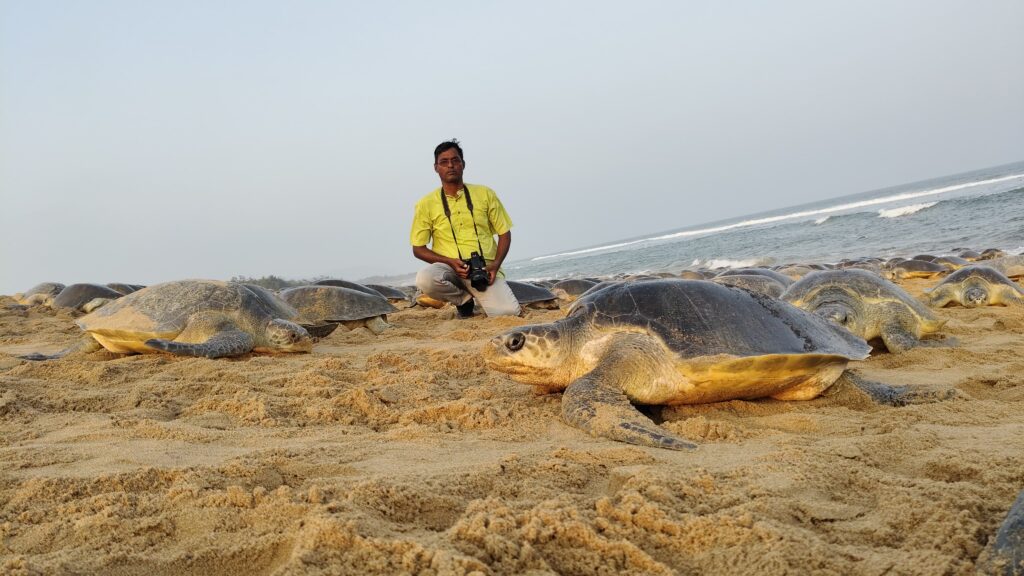
Odisha, located on the eastern coast of India, has long been recognized as one of the most significant habitats for sea turtles, particularly the Olive Ridley turtles (Lepidochelys olivacea). These small, endangered turtles are known for their remarkable mass nesting events, or “arribadas,” where thousands of females come ashore to lay their eggs. Among the many coastal regions of Odisha, the Rushikulya river mouth has recently made headlines for a groundbreaking milestone—11 lakh nestlings observed during the 2025 nesting season, a feat that has captured global attention and highlighted the success of conservation efforts in the region.
The Olive Ridley Turtle: A Vulnerable Species
Olive Ridley turtles, recognized for their distinctive olive-colored shells, are the most numerous of the seven sea turtle species worldwide. However, they face numerous threats to their survival, including habitat destruction, accidental capture in fishing nets (bycatch), climate change, and illegal trade of their eggs and shells. The International Union for Conservation of Nature (IUCN) lists the Olive Ridley as “Vulnerable,” with certain populations, especially in the Indian Ocean, facing heightened risks.
Rushikulya: A Premier Nesting Site
Rushikulya, an estuary located along Odisha’s coastline, serves as one of the primary nesting sites for Olive Ridley turtles. Each year, the region witnesses the “arribada,” where thousands of turtles converge to lay their eggs on the sandy beaches. The site’s ecological importance cannot be overstated, as it plays a crucial role in the conservation of this species.
In 2025, Rushikulya reached a historic milestone when over 11 lakh nestlings were recorded, marking a dramatic increase in the population. This achievement is a direct result of years of tireless conservation efforts and support from both local communities and governmental agencies.

Insights from Key Conservationists
To better understand the success of the Olive Ridley turtle conservation efforts in Odisha, we spoke to four key individuals who have dedicated much of their careers to this cause.
Mr. Rabindranath Sahu: Secretary, Rushikulya Sea Protection Committee
Mr. Sahu, a warm and dedicated individual, has spent years working at the Rushikulya site. As Secretary of the Rushikulya Sea Protection Committee, he oversees the conservation of the turtles. He explains that after the mating season in February and March, the turtles lay their eggs on the beach, entering a 30-50 day hatching window. He also highlights that about 60% of Olive Ridley turtles in India migrate to Odisha, with 60-90% of them specifically choosing the state’s coastline for nesting.
“I was only a student when I took up the cause. But I had pledged my life to the turtles the day I saw their mass nesting ritual,” said Mr. Sahu. He remains a bachelor and considers the turtles his babies.
On a span of 54 km and 28 villages, Mr. Sahu has made an effort to create awareness about turtles. “When I was a kid, we used to eat the eggs of turtles because we had no idea of them being endangered whatsoever. It was on the arrival of Mr. Bivas Pandav that I learnt more about them and understood the gravity of conservation. It took me 6 years to make the villagers realise the importance of turtle conservation too. Today, we all worship turtles and even celebrate World Turtle Day on 23rd May every year.”
Dr. Bivash Pandav: Marine Turtle Researcher
Dr. Bivash Pandav, a scientist at the Wildlife Institute of India, Dehradun, is one of the pioneers in studying marine turtles at Rushikulya. He first documented the mass nesting event at the site in March 1994, and the Odisha Forest Department began protecting the site two years later. Dr. Pandav emphasizes the global significance of Odisha, stating that out of only five sites worldwide where Olive Ridley turtles’ nest, two are located in Odisha, with the others in Costa Rica and Mexico.

Dr. Basudev Tripathy: Senior Scientist, Zoological Survey of India
Dr. Basudev Tripathy, a senior scientist specializing in sea turtles, has been involved in turtle conservation since 1996. He describes Olive Ridley turtles as vital to marine biology and highlights the extensive efforts to protect them, both at the federal and state levels. Dr. Tripathy explains that while the turtles are relatively safe during nesting on the beaches, the real threat comes when they are in the water. To mitigate this, the government has established a 5 km barrier zone around nesting sites, allowing only traditional fishing while prohibiting mechanized fishing.
Dr. Tripathy also discusses the use of turtle telemetry, where satellite tracking devices are attached to turtles to study their movements and behaviors. However, he notes the high cost of this method—each transmitter costs 5 lakh rupees, with a signal cost of 5 dollars per signal. As a result, the tagging process has been limited, though it remains invaluable for understanding the turtles’ migratory patterns. Dr. Tripathy concludes by stressing the mystery surrounding the Olive Ridley turtles, saying, “A lot about these turtles remains to be known. We aren’t remotely close to knowing enough about them. That’s the beauty of them.”

Dr. Kartik Shanker
Affiliated with the Indian Institute of Science and the Dakshin Foundation, Prof. Kartik Shanker works on ecology and evolution of both terrestrial and marine fauna, and has worked on olive ridley turtles at Odisha since the late 1990s. Dakshin Foundation has monitored turtles at Rushikulya since 2007, including the potential impact of climate change on sea turtle populations through its impact on sex ratios.
His genetics research in the early 2000s showed that the olive ridley population on the east coast of India is ancestral to those found in the Pacific and Atlantic Oceans.
“In Odisha, we monitor turtles from the time they arrive in offshore waters to their solitary and mass nesting, and finally hatching success. We also monitor temperatures and sex ratios”
“Since sea turtles are long-lived and mature only after 10 – 15 years, we cannot discern population trends from short-term data like 2-3 years; we need something substantial like 15-20 years of data to tell if the population is increasing or decreasing,” said Dr. Shanker.
Having now monitored this population for nearly two decades, he affirms that the number of turtles and nests has increased since the early 2000s, despite about 10,000 turtles dying every year in fisheries related mortality. However, threats from coastal development and climate change can affect the population in future.

The Road Ahead for Turtle Conservation
The unprecedented nesting event of 11 lakh Olive Ridley nestlings at Rushikulya is a major victory for conservationists, but challenges remain. Despite the successes, threats such as climate change, bycatch, and illegal poaching continue to pose risks to the species. Continued efforts from local communities, government bodies, and conservation organizations are essential to ensure the turtles’ long-term survival.
The collaborative work in Odisha serves as a model for turtle conservation worldwide. As the Olive Ridley turtles continue to thrive in the region, their story offers hope that with dedication, protection, and sustainable practices, we can preserve our natural world for future generations.
Conclusion
The 2025 record of 11 lakh nestlings at Rushikulya not only highlights the success of Odisha’s conservation initiatives but also underscores the global significance of protecting the Olive Ridley turtle. With continued efforts from experts like Mr. Rabindranath Sahu, Dr. Bivash Pandav, and Dr. Basudev Tripathy, along with the involvement of local communities, the future of these remarkable creatures looks promising. However, the road ahead requires sustained commitment to safeguarding both the turtles and the ecosystems they inhabit.